
AI watermarking is not the real trap
High-risk AI obligations: delayed to 2027. Synthetic-content traceability: December 2, 2026. Read that again.

TL;DR
The article makes five claims that matter.
Claim 1: The EU deliberately kept the December 2, 2026 synthetic-content traceability deadline while pushing heavy high-risk obligations back to 2027 - that asymmetry tells you where enforcement energy lands first.
Claim 2: Provider logs already create a chain of custody before any watermark is deployed - the artifact trace is the second layer, not the first.
Claim 3: Civil litigators, employers and rights-holders will activate that infrastructure before intelligence agencies do. Employers through direct tenant access, litigators through ordinary civil discovery.
Claim 4: The “EU built a dissident registry” framing is wrong - Article 50 mandates system-level provenance, not user-ID embedding, and GDPR actively works against personal-data watermarking.
Claim 5: Anonymity in AI is now an economics problem - exiting the traced stack requires hardware, zero-data-retention contracts or legal muscle that a retail subscription cannot buy.
Last week, the EU’s Digital Omnibus deal pushed major high-risk AI obligations for many Annex III systems from August 2026 to December 2027, with some Annex I product-linked obligations moving to August 2028.
In the same package, Article 50’s synthetic-content transparency rules stayed on a hard track, with machine-readable marking and disclosure obligations tied to December 2, 2026.
Most people will read that as relief.
I read it differently.
Brussels gave companies more time to sort out the slow, ugly governance work around high-risk workflows. At the same time, it gave AI providers less time to make generated content traceable.
One clock moved back. The other started ticking louder.
That matters because AI watermarking sounds like a niche technical feature. It is not. It is the start of a new chain of custody for synthetic content.
What AI watermarking is
AI watermarking is a machine-readable signal embedded into AI-generated text, images, audio or video so another system can detect that the output was artificially generated or manipulated. In image systems, that increasingly sits inside provenance stacks such as C2PA content credentials, which attach signed metadata about the origin and modification history of a file.
The important point is simple:
The watermark is not there for your eyes. It is there for software, platforms, auditors and eventually courts.
OpenAI said in 2024 that images from its tools would carry C2PA metadata and Google’s SynthID watermarking technology, which is exactly the direction regulators want the market to take. The EU AI Act’s Article 50 now gives that direction a deadline. December 2, 2026.
What Article 50 actually does
Article 50 is a transparency rule.

Providers of AI systems that generate synthetic audio, image, video or text content must ensure the outputs are marked in a machine-readable format and detectable as artificially generated or manipulated. Deployers of deepfakes must also disclose the artificial nature of the content to end users in the cases covered by the Act.
That is the legal spine.
And here is the first correction to the lazy civil-liberties take.
Article 50 does NOT require a provider to stamp your passport number, customer ID or legal name into every image or paragraph you generate. The rule is about content provenance at system level - proving the artifact is synthetic - not mandatory public identity tagging.
GDPR pushes in the same direction. Embedding personal data into every circulating artifact would collide with data-minimization and purpose-limitation principles unless a provider had an unusually strong legal basis for doing it.
So the simplistic story of “the EU just built a dissident registry” is weak.
The real story is actually worse.
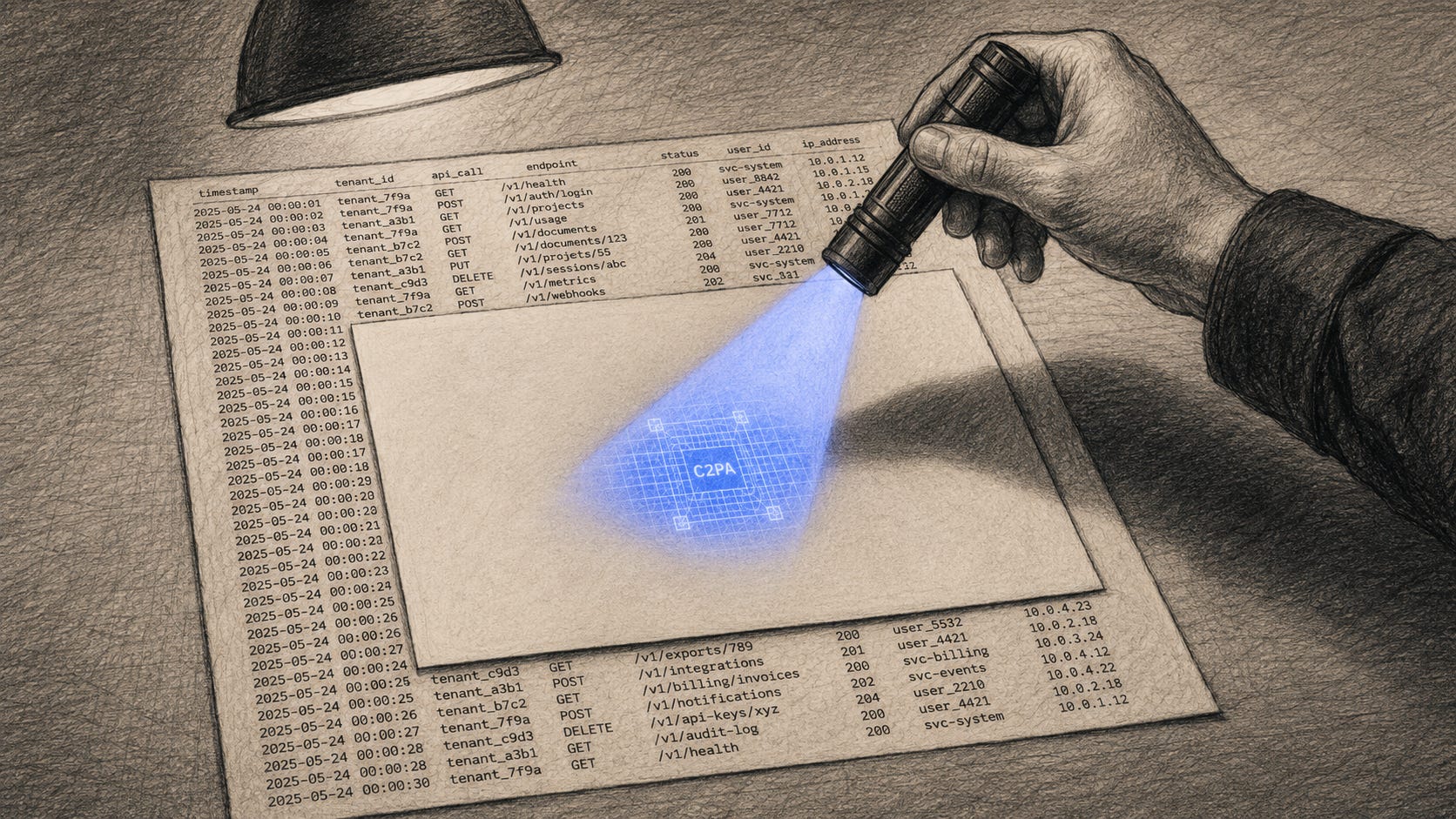
Because the trace does not start with the watermark.
It starts with the logs.
The trace already exists
Every call to a major AI service is already a structured event.
OpenAI retains API prompts and completions for about 30 days by default for abuse monitoring and operational purposes, with zero-data-retention available only for eligible customers under special conditions. Azure OpenAI keeps abuse-monitoring data on roughly the same horizon unless a customer gets approved for modified abuse monitoring. Anthropic reduced Claude API log retention from 30 days to 7 days in September 2025, with flagged content retained up to 2 years and abuse-score metadata up to 7 years.
That means the server-side trace is already there.
Who called the model. When they called it. Which tenant they belonged to. Which safety systems fired. In many cases, the prompt and the output themselves.
Watermarking adds the second trace.
One trace lives inside the provider.
The other travels with the artifact.
Put those two together and AI output starts to behave like evidence.
The control layer always arrives dressed as safety. Then audit, legal and procurement wire it into everything. Quietly. Thoroughly. Permanently.
Why courts matter more than spies
Most people would jump straight to “intelligence agencies”.
No.
The first aggressive users of this infrastructure are more likely to be litigators, employers, rights-holders and internal investigators. We already have a working proof of concept. In 2025, a U.S. federal court ordered OpenAI to preserve consumer ChatGPT and API content beyond its normal 30-day deletion window as part of the New York Times copyright lawsuit. OpenAI contested the order, the hold ran from June to September 2025, and the data was not actually handed over.
But the mechanism worked exactly as described: a civil lawsuit activated a legal override of the provider’s standard retention policy. The data was frozen. The question of who gets to see it is now a matter of further litigation, not provider policy.
The employer case is more direct than any litigation. Most enterprise AI tools run inside a corporate tenant - Microsoft 365 Copilot, Azure OpenAI, Salesforce Einstein, ServiceNow.
The employer is the deployer. They own the audit logs. They can query which prompts were sent, by which employee account, at what time. No court order required. No subpoena. Just an IT admin with the right permissions and a reason to look.
That has a specific consequence most employees have not thought through.
Whistleblower protections are real - in law.
But they were designed for a world where the employee controls the record: the printed document, the personal email, the private conversation. In a corporate AI tenant, the generation event is logged before the artifact ever leaves the system. The employer has architectural access to the draft before the employee decides whether to send it. Legal protections exist somewhere later. The exposure happens the moment employee starts drafting.
That matters because civil discovery is trivial. It does not need a special national-security theory. It just needs a lawsuit, a subpoena and a provider that holds useful records.
So the new causal chain looks like this.
Article 50 pushes providers to mark synthetic output. Providers already keep logs that tie output generation to accounts and tenants for days or weeks by default. Courts and investigators can reach those logs through ordinary legal process.
The result is a system where synthetic content becomes easier to authenticate, easier to trace and easier to weaponize in disputes.
That is the real shift.
Where the economics bite
Now the uncomfortable part.
The people who keep meaningful anonymity in the next phase of AI are not simply the most “tech-savvy.” They are the people who can afford to leave the cheap stack behind.
Mainstream usage is cheap because someone else runs the model, stores the logs and increasingly marks the output. Consumer subscriptions cluster around low monthly price points, and multiple cost comparisons find that for small teams and normal usage levels, API access stays cheaper than self-hosting once hardware, power and engineering time are included.
But the private path costs more.
Running open-weight models locally or in a controlled environment means buying hardware, accepting more friction and carrying the operational burden yourself. Analyses of self-hosting economics in 2026 show break-even against premium hosted APIs typically appears between 5 and 50 million tokens per month depending on model tier, and only after absorbing GPU, power and engineering overhead.
So yes, this is technical.
It is also economic.
A real privacy posture in AI now requires one of three expensive things:
hardware you control,
contracts you can negotiate or
legal sophistication strong enough to constrain what the provider keeps.
OpenAI, Azure and Anthropic all present stronger retention controls as exceptions for eligible or approved customers, not as the retail default.
That creates a three-tier system.
At the bottom sit retail users and small creators:
Cheap tools. Full provider control. Growing artifact traceability.
In the middle sit large enterprises:
They have enough volume and procurement muscle to ask for zero-data-retention, modified monitoring and private deployment terms.
At the top sit actors with their own compute:
They decide what gets logged, what gets marked and what leaves the box.
That is where the real divide sits.
Not between people who use AI and people who reject it.
Between people who can pay for opacity and people who rent legibility.
The steelman - and why it still leads here
The strongest counterargument is straightforward.
Watermarking and provenance are necessary. Without machine-readable traceability, deepfakes, synthetic fraud and manipulative political media become harder to detect at scale. That is true.
I maintain that point.
A world with no provenance is a gift to scammers.
But the price of provenance is not neutral.
The better the provenance layer gets, the more expensive anonymous creation becomes. Large firms can absorb that price. States and organized criminals can route around it.
The people who take the hit first are smaller builders, pseudonymous creators, employees and dissidents who were relying on cheap mainstream tools because that is what they could afford.
This is why the regulatory story matters far beyond Brussels.
The EU did not invent the surveillance substrate. The vendors already had one in their logs. Europe just gave the artifact side of that substrate a deadline.
The 90-day collapse points
Two claims in this article are predictions, not facts. Here is how to test them.
First test.
By September 1, 2026, at least one publicly reported legal case - civil litigation, employment dispute or rights enforcement action - explicitly cites AI provider logs or watermark metadata as evidence or the subject of a discovery request, beyond the existing NYT preservation order. If that happens, the “courts before spies” mechanism is activating at scale. If no new case surfaces by September, the NYT case remains an isolated proof of concept and the timeline is slower than my article implies.
Second test.
By September 1, 2026, at least one of OpenAI, Azure or Anthropic announces zero-data-retention as a default setting for all paid tiers, not an approved exception. If that happens, the economics argument weakens - the cost of opacity drops to the price of a subscription. If it does not, the three-tier structure holds and the gap widens.
The conclusion is uncomfortable and simple.
Europe delayed the hard part of AI governance for many companies. Europe kept the deadline for synthetic traceability.
Most people will pay for convenience.
But convenience comes with a traceable trail.
Before you close the article
These Signals reflect conversations I am having with executives right now, just written down.
If this helped you see your organization’s blind spots more clearly, do two things.
In fact, for private persons a local hardware with a local AI model is in the long run cheaper than a subscription.