
The Enterprise Adoption Paradox
30,000 Trained. 54,000 Fired. The Efficiency Algorithm Is Running.

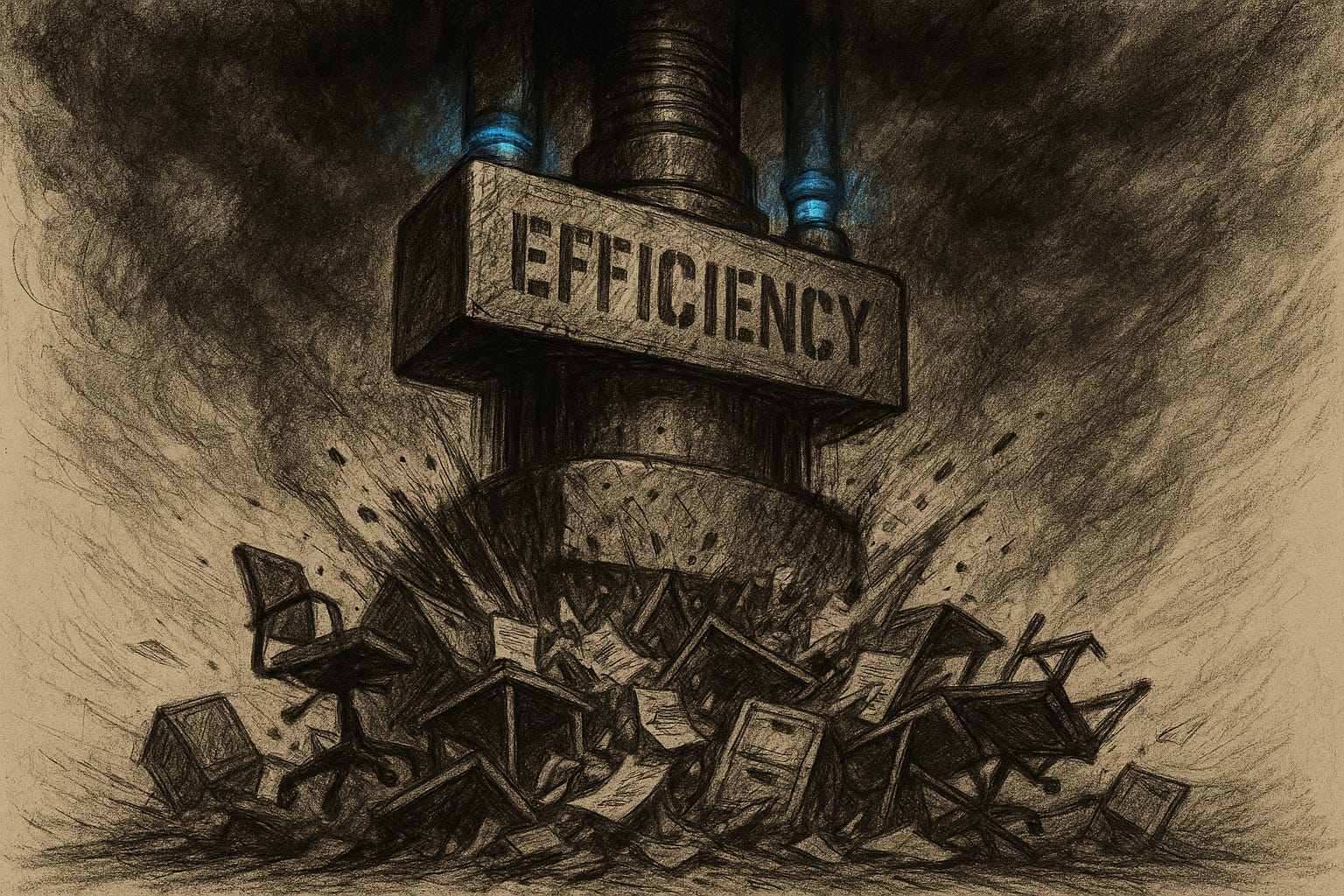
Thirty thousand people just trained on Claude.
Fifty-four thousand received termination notices.
These are not two stories. They are one system revealing itself.
The Paradox
On December 8, Accenture announced a landmark partnership with Anthropic. The numbers looked impressive: 30,000 professionals, enterprise-wide training, integrated Claude into core workflows. The business case was evident - productivity gains, margin expansion, competitive moat.
But the timing was...
Exactly 72 hours earlier, the US economy shed 54,694 jobs with AI explicitly cited as the cause. October 2025 had already marked 31,039 layoffs. By November, the pace accelerated. Everyone can SEE the pattern now.
So here’s the paradox:
Organizations are adopting Claude at unprecedented scale while erasing the labor market those organizations depend on for demand, retention and social stability.
The Accenture partnership actually sets a new template.
It is the moment when the infrastructure moat you have been reading about for three weeks collides with human reality.
The Pattern: How Productivity Flows Upward (And Why You Can’t Escape The Trap)
Let me trace the causal mechanism. But first, let me tell you where this lives.
I have been in Partner meetings where the CFO says: “For our shareholders we need 15% margin expansion. We have three paths: Price increases (competitors undercut us), headcount expansion (capital intensive), or automation (software replaces people).”
The room goes silent. Everyone knows the spreadsheet logic. Everyone knows what comes next.
The software wins. It always wins. Because the spreadsheet is honest. And humans are expensive.
Now scale that conversation across every major consulting firm, every enterprise with a margin target, every publicly traded company answering to shareholders. The playbook doesn’t change. Only the timeline accelerates.
This is where Accenture’s partnership lives. Not as innovation, but as inevitability.
Here is the actual mechanism:
The hyperscalers own the infrastructure. They raised $88B in debt to build and control compute. This gives them three structural advantages:
First: They control the frontier models.
OpenAI, Google, Anthropic, xAI - all depend on hyperscaler compute. The models are not independent. They are creatures of infrastructure. And infrastructure has landlords.
Second: They control the enterprise workflow.
Accenture’s announcement is the proof point. But here’s what’s actually happening beneath the headline:
When Accenture trains 30,000 people on Claude, they are not simply teaching a tool. They are creating custom workflows. Custom data pipelines. Custom prompt libraries built on Claude’s specific reasoning patterns. They are embedding Claude into delivery mechanisms that now assume Claude exists.
This creates a lock-in that software licensing calls “stickiness,” but what it actually is, is a trap.
Here’s how the trap works:
A client - let’s say a Fortune 500 company - adopts Claude through Accenture. The first project works. Productivity lifts 20%. The client wants more. Accenture builds the second project on top of the first one’s workflows. Now the client has 50 Claude-native processes running. They have trained 500 of their own people on Claude. They have built internal tooling that only works with Claude’s API.
Now the client wants to evaluate GPT-4 or Gemini. But here’s the friction: They would have to retrain 500 people. Rebuild 50 workflows. Re-architect their internal tooling. The switching cost is $5M and six months of operational disruption.
So they don’t switch. They are locked in.
This is not Apple’s vertical integration illusion (buying the supply chain). This is something worse. This is behavioral lock-in. The more you use the tool, the more expensive it becomes to leave.
Accenture knows this. Anthropic knows this. The client knows this. The trap is the feature.
Third: They capture the productivity gains - all of them.
Here is what actually happens:
Accenture trains 30K people on Claude.
Those people become more productive. Let’s say 15 - 30% productivity uplift (the conservative estimate).
Accenture’s cost per engagement goes down.
Accenture’s margins go up.
Anthropic’s valuation expands (enterprise adoption proof point).
The clients’ operational costs drop.
The benefits flow upward to capital.
Now here is what happens to labor:
Organizations see productivity gains without adding headcount.
Hiring freezes. Or worse - rightsizing. Cut 10% of the workforce, deploy the tool, maintain output.
The 54,694 jobs erased in the last 60 days are direct casualties of this equation.
The labor market atomizes. Freelancers, contractors, specialized workers - their optionality collapses because the tool has replaced them.
This is not automation in the abstract. This is a specific architecture:
Infrastructure Owner (Hyperscaler) →
Model Provider (Anthropic) →
Enterprise Adopter (Accenture) →
Displaced Worker (You, maybe)
Each layer captures value. Each layer downstream loses it.
The System Revealed: The Bifurcation Completes
Two weeks ago, I described the “Great Bifurcation” - capital consolidating into infrastructure while labor was being liquidated into precarity. You asked: “But how does this actually work? Where does the friction happen?”
The answer is: Accenture. The partnership is the friction point where the system becomes visible.
Accenture is the bridge. They are capital-rich, labor-dependent and now model-dependent. They have chosen to invest in model adoption instead of people. This choice ripples:
For Accenture:
30K trained professionals become a competitive weapon
Margins expand without headcount expansion
Enterprise customers see value, so they expand the contract
For Anthropic:
30K new users is proof of enterprise adoption at scale
This justifies the $20B+ valuation
This enables the next fundraise at higher terms
For enterprise customers:
Productivity gains without labor cost
Margin expansion flows to shareholder returns or price cuts for customers
Competitive advantage for now (well, until everyone has Claude)
For displaced workers:
Job market contracts
Wage pressure increases - more people, fewer roles
Optionality evaporates
Reskilling narrative intensifies , as if you can out-train a model that costs 1/100th your salary
This is the new system operating exactly as designed.
The infrastructure cartel creates the models. The models enable enterprise productivity. Enterprise productivity destroys labor market optionality. Labor market destruction reduces wage pressure, which reduces enterprise costs, which increases margins, which validates the infrastructure cartel, which attracts more capital.
The system feeds itself.
And we are watching it happen in real-time. The moment when the bifurcation - the split between winners and losers - becomes undeniable.
The Accenture Playbook (And Why Every Enterprise Will Copy It)
This is not Accenture being creative. This is Accenture reading the same memo everyone else is reading.
The playbook is:
Pick one model. Don’t dilute across five. Choose Claude, or Gemini, or GPT-4, and commit.
Train at scale. 30K is not a pilot. It is signal. It is proof that the model is now operational infrastructure for the firm.
Integrate into core workflows. Don’t bolt it on. Embed it into hiring, delivery, PM, analytics, consulting - everywhere.
Measure productivity. Show the investor community, the board, the shareholders that adoption = margin expansion.
Rightsize the workforce. You don’t need to say it loudly. But everyone knows what comes next. You trained people on a tool because you don’t need as many people to do the work.
Now multiply this by every major consulting firm (BCG, McKinsey, PwC), every large enterprise (AWS customers, Microsoft clients), every software-dependent operation.
If Accenture’s playbook works - and the fact that they announced it publicly means they believe it will - then the adoption curve accelerates.
And the labor market consequences accelerate with it.
The Hidden Crux: Who Pays For The Transition?
There is a question that no one is asking loudly enough.
If productivity gains flow to capital (Anthropic, Accenture, enterprise customers), but the costs of transition flow to labor (job loss, wage pressure, precarity), then who pays for the transition from human labor to AI labor?
The answer is:
Labor pays. Capital collects.
This is NOT a hypothesis. It is mathematically inevitable.
The 54,694 jobs erased in 60 days have families. They have mortgages. They have healthcare dependencies. They have student loans. The transition costs - retraining, relocation, mental health impact, social dissolution - are borne entirely by the people losing the jobs.
Meanwhile, Anthropic’s valuation expands. Accenture’s margins expand. The infrastructure cartel consolidates.
Again and again. This is the Bifurcation completing. Right before our eyes.
The Closing Question (And The Real Diagnosis)
The infrastructure cartel will consolidate. The models will improve. Enterprise adoption will accelerate.
These things are true.
But there is one assumption beneath all of this that nobody is testing:
What happens to labor demand when productivity gains are broadly distributed?
If every enterprise adopts Claude, and every enterprise sees 15 - 30% productivity uplift without proportional headcount expansion, then labor demand contracts. Wages compress. Optionality evaporates.
At that point, the economy faces a structural problem: Productivity is decoupled from employment.
This is not a recession. It is not a cyclical event. It is a fundamental reorganization of how value is created and distributed.
The Accenture partnership is the first domino.
What to Watch: the 90-Day Collapse Points
Here is what would validate or invalidate this diagnosis:
Test 1: Churn on Claude Enterprise Adoption
The Metric: Retention rate among the 30K Accenture professionals training on Claude
The Test: If adoption sticks above 85% within 90 days, it is proof of category shift (from tool to infrastructure)
The Falsification: If adoption falls below 70%, it means the playbook doesn’t work and the productivity gains are illusory
Timeline: By March 31, 2026
Test 2: Competitive Mimicry Acceleration
The Metric: Announcement of similar “at-scale enterprise model adoption” from BCG, McKinsey, PwC, or Deloitte
The Test: If we see three or more Fortune 500 consulting/enterprise players announce similar programs by Q1 2026, the playbook is replicable
The Falsification: If Accenture remains isolated in this strategy, it is an outlier play, not a system shift
Timeline: By February 15, 2026
Test 3: Labor Market Response (Job Posting Contraction)
The Metric: Count of job postings in traditional enterprise roles - management consultants, business analysts, junior coders
The Test: If postings contract 10%+ YoY in Q1 2026 (seasonally adjusted), labor displacement is accelerating
The Falsification: If job posting growth remains flat or positive, the model adoption is additive (hiring alongside tools), not substitutive
Timeline: By March 15, 2026
Test 4: Enterprise Margin Expansion Attribution
The Metric: Accenture’s Q4 2025 gross margin vs. Q4 2024
The Test: If Accenture reports gross margin expansion of 200+ basis points attributable to “operational efficiency” (which means automation), the playbook is delivering to capital
The Falsification: If margins are flat or contracting despite 30K Claude adoptions, the productivity gains didn’t materialize
Timeline: By February 28, 2026
Why This Matters (And Why No One Is Saying It)
The Accenture partnership is being celebrated in the tech press as a “win for Anthropic” and a “validation of enterprise AI adoption.”
It is both of those things. It is also a warning.
It is the moment when the infrastructure moat you have been reading about collides with your job.
It is the moment when the productivity gains you have been hearing about flow away from you and toward capital.
It is the moment when you realize that the reskilling narrative - “just learn to use AI, and you will be fine” - is not a solution.
It is gaslighting.
Here is what is actually true:
If you are a junior consultant, senior analyst or mid-level operator: Your job is being bid down by a model that costs $20/month
If you are a freelancer or contractor: Your market is being flooded by people displaced from enterprise jobs, all competing for the same gigs
If you are a manager: Your team is getting smaller, your expectations are getting bigger, and the tool that was supposed to help is actually a proxy for “do more with fewer people”
If you are a company with pricing power in the B2B space: Congratulations, you can extract the productivity gains. You have three years before everyone has the same tools and pricing power evaporates
The Bifurcation is not coming sometime in future. It is already here.
By March 31, 2026, we will know if the dominos are falling.
Until then, watch the labor market. Not the model announcements. Not the valuation rounds. The labor market.
That is where the system’s actual logic is revealed.
That is where the Bifurcation happens.
This is a public-facing Signal analysis. The proprietary frameworks and strategic implications are reserved for paid subscribers in The Analysis section.
Sources
Accenture and Anthropic Launch Multi-Year Partnership. Anthropic newsroom, December 8, 2025
Final Round AI - November 2025 Layoff Report. “54,694 jobs were eliminated due to AI in 2025.” Challenger, Gray & Christmas data, compiled through November 2025
Challenger, Gray & Christmas. October 2025 Job Cut Report. “31,039 job cuts were attributed to AI in October 2025.” Released November 2025.
WebProNews - “Tech’s AI Debt Tsunami: $121 Billion Bond Binge Fuels Data Center Frenzy.” November 23, 2025. “Alphabet, Meta Platforms, Oracle, Amazon and Microsoft have collectively issued more than $121 billion in bonds this year to bankroll sprawling AI data center empires, according to a Bank of America analysis.”