
Infrastructure as Moat: The $45 Billion Check That Ended the Model War
Capital access now determines who builds frontier models. Everyone else rents.

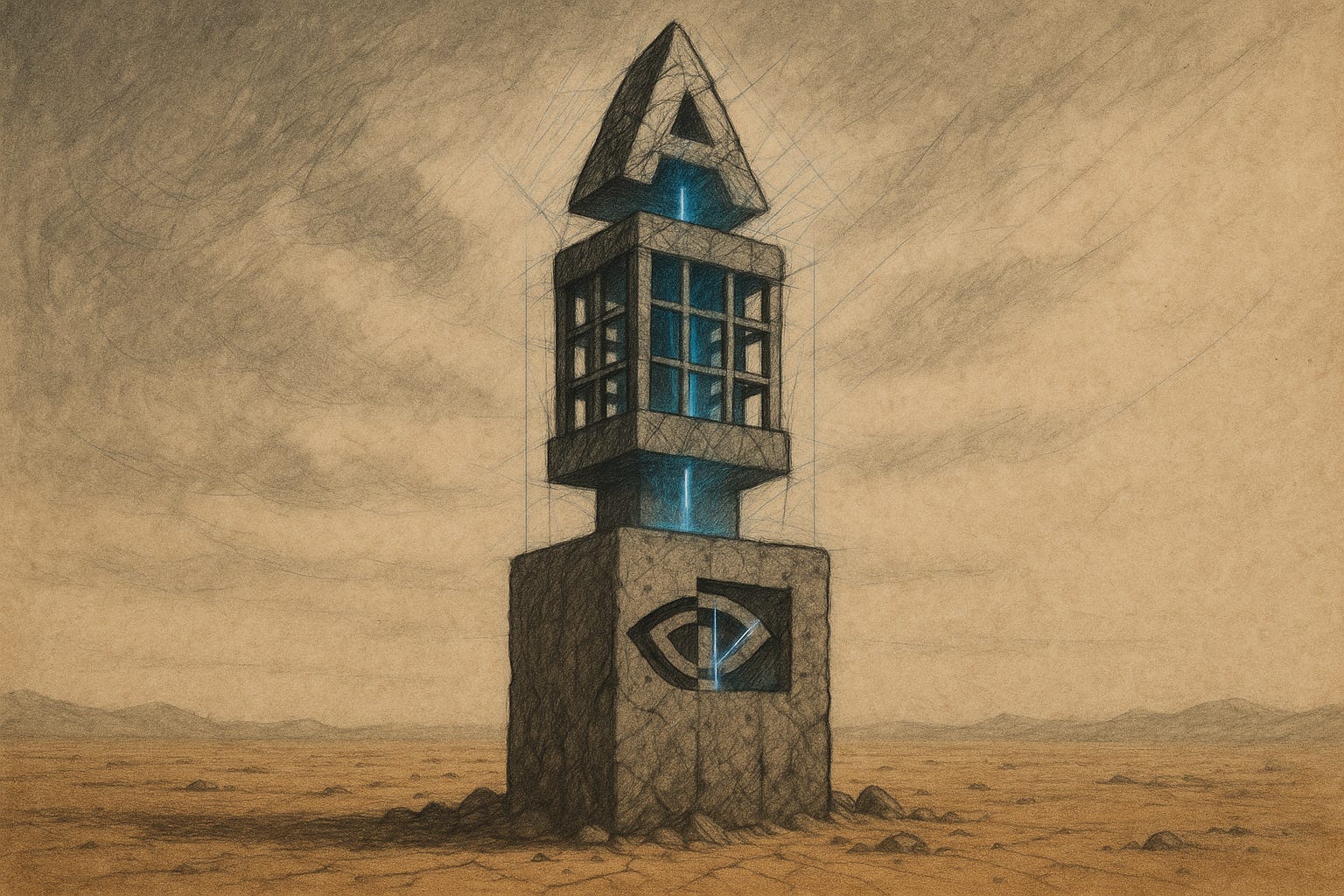
The announcement between Microsoft, NVIDIA and Anthropic on November 18 meant one thing:
Who gets to stay in the game is now determined by who owns the infrastructure.
That is the actual news. Models are secondary.
For a decade AI competition played out in research labs. Which organization trained the best model? OpenAI wins. DeepMind advances. Anthropic breaks through. Winner takes market share. Talent follows. Capital flows to the victor.
That era has closed.
By November 2025 the frontier between “best model” and “accessible model” had collapsed. GPT-5.1, Gemini 3, Claude Sonnet 4.5, Grok 4.1, Baidu’s ERNIE 4.5 - these models are differentiated by degrees, not categories. They are all competent. They are all available. None holds a decisive monopoly on capability.
Compute capacity has displaced innovation as the primary constraint. And capacity, unlike raw genius, follows capital.
The Math: Infrastructure as the New Moat
Anthropic, Microsoft and NVIDIA revealed a $45 billion commitment on November 18. Here is what actually happened:
Anthropic commits $30 billion to purchase computing capacity from Microsoft Azure over 8+ years, powered by NVIDIA hardware
Microsoft and NVIDIA inject $15 billion into Anthropic as investors - $5 billion from Microsoft , $10 billion from NVIDIA
Claude models (Sonnet 4.5, Opus 4.1, Haiku 4.5) now deploy across all three US hyperscalers (Azure, AWS, GCP) - a distribution advantage no competitor has achieved
One gigawatt contract locks in future capacity, a deal structure that takes years to manufacture and allocate
This arrangement looks circular - Microsoft invests in Anthropic, Anthropic buys compute from Microsoft , Microsoft buys chips from NVIDIA , NVIDIA invests in Anthropic. Everyone profits as long as everyone keeps spending.
That observation is right. But it misses the deeper constraint.
Previous rounds of circular financing (2022 - 2024) were driven by capital scarcity and narrative hype. Companies invested in AI because it was “THE category”. Valuations were speculative.
November 2025 is different. The constraint is physics.
NVIDIA ‘s capacity is genuinely sold out through 2026. One gigawatt requires hundreds of thousands of chips. Supply chains take years to build. Manufacturing plants (fabs) take 5+ years to construct. Hyperscalers are spending out of existential necessity. They know 2026 demand is locked and 2027 will be scarcer.
NVIDIA’s Q3 FY2026 results confirm this. Revenue: $57.0 billion (up 62% YoY). CEO Jensen Huang stated plainly:
“Sales of Blackwell are unprecedented, and our cloud GPUs are sold out.”
This is the reality of physical constraint.
Why This Destroys Startups
For a startup to build a frontier AI model in 2025, they need:
Access to hardware (NVIDIA chips) - constrained
Access to cloud capacity - sold out through 2026
Capital to pay for infrastructure, $1-10B for serious scale
Capital raised upfront, not on consumption models
Anthropic solved first two by binding itself to Microsoft . OpenAI solved it via their 2023 Microsoft partnership. The others - smaller labs, ambitious European teams, Asia-based competitors - face an infrastructure gap they cannot close with clever code or superior research.
Google has TPU capacity.
Amazon has AWS capacity.
Both are now ring-fenced by competing relationships.Microsoft owns 27% of OpenAI, so they have strategic reasons to constrain OpenAI’s compute access while expanding Anthropic’s.
Google is contractually committed to service Anthropic’s scale needs.
Amazon is spread across thousands of cloud customers.
The shortage is real. The allocation is political.
A startup with $100 million and a brilliant founding team faces a hard wall. They cannot rent compute. They can fine-tune. They can build applications on rented inference. They cannot innovate at frontier scale.
This fundamentally tilts the playing field toward capital-rich incumbents and away from cash-constrained founders.
I remember fighting for a $50,000 Google credit grant when we started CapabiliSense. It felt like a lifeline. Today, $50,000 buys you about 12 minutes of frontier training time. The ladder has been pulled up.
The Circular Financing Paradox
Coming back to the circular nature of these deals: Microsoft invests in Anthropic. Anthropic buys compute from Microsoft . Microsoft buys chips from NVIDIA. NVIDIA invests in Anthropic. Everyone profits as long as spending continues.
If inference ROI is missing, this collapses. Enterprise demand must accelerate. Less than half of IT leaders said their AI projects were profitable in 2024, with 33% breaking even and 14% recording losses. The spending is projected on the belief that 2026-2027 enterprise inference demand will be real.
If it misses, we have a genuine bubble.
But the infrastructure investment itself is not speculative. Capacity is physical. Chips cannot be un-built. Fabs cannot sit idle at $5 billion per construction. Whether ROI materializes or not, the infrastructure gets built. That is the moat.
The question is whether the economics justify the capex. That test comes in 2026-2027.
What This Means for the Market
For Anthropic: Valued around $350 billion (up from $183 billion two months prior), Anthropic is now the only frontier model with distribution across all three hyperscalers. This matters because enterprises demand multi-cloud optionality for business continuity. Claude now offers it. OpenAI misses this (locked into Microsoft ). Google ‘s own models miss this (locked into GCP). This is a structural differentiation that compounds over time.
For Microsoft : The company reduced dependency on OpenAI (which still captures 27% of its AI equity) by diversifying into Anthropic. It also locked Anthropic compute into Azure, driving additional NVIDIA chip purchases. This is a hedge, an expansion and a cost allocation - all in one move.
For NVIDIA : The company locked in $10 billion of direct Anthropic investment plus $30 billion of indirect revenue (Microsoft paying for chips to power Anthropic capacity). For a company producing $57 billion in quarterly revenue, this is predictable, multi-year runway.
For smaller startups: The infrastructure moat is now absolute. Competition requires capital access. Venture will consolidate around funded models (like Anthropic) or application layers (where compute is rented, not owned). Scrappy indie teams building frontier models are increasingly ruled out by physics.
For enterprises: They face genuine multi-cloud optionality for frontier models - but only if they commit to long-term infrastructure contracts. The upside is competition. The downside is lock-in. Because contracts are multi-year and switching costs are enormous.
The Signal Was Already Sent
The deal announced on November 18 was formalization. The signal started months earlier.
When NVIDIA sold out through 2026. When chip prices remained flat despite massive demand. When every hyperscaler made billion-dollar infrastructure commitments simultaneously. The math had been done. The capacity was the scarce resource.
The announcement was just the paperwork.
INFRASTRUCTURE IS NOW THE MOAT
Capital access determines which models get built at scale. Compute capacity gates innovation. This favors hyperscalers, capital-rich startups and incumbents with chip partnerships.
It leaves small teams and lean labs exposed.
If this holds, the next 24 months will look like consolidation, not disruption. Fewer frontier models will be trained. More energy will go into optimization and deployment. This is where startups can still compete. Venture capital will shift away from model-building toward application infrastructure.
The game changed. But the outcome was decided months earlier when the chips ran out.
Here is the deal.
If you aren’t subscribed, subscribe. It takes two seconds. It costs nothing. It separates the signal from the noise.
If you have a voice, restack it. Let your network see the signal.
And if this landed for you, if it gave you the language to name the problem, upgrade to Paid.
It is the only way to support the weekly Signals and influence the next deep-dive Analysis.
Sources
OpenAI Blog (Nov 12, 2025). “GPT-5.1: A smarter, more conversational ChatGPT”: https://openai.com/index/gpt-5-1/
Google Blog (Nov 17, 2025). “A new era of intelligence with Gemini 3”: https://blog.google/products/gemini/gemini-3/
DataCamp (Nov 17, 2025). “Grok 4.1: Improvements in EQ, Writing, Reliability, and More”: https://www.datacamp.com/blog/grok-4-1
Artificial Intelligence News (Nov 11, 2025). “Baidu ERNIE multimodal AI beats GPT and Gemini in benchmarks”: https://www.artificialintelligence-news.com/news/baidu-ernie-multimodal-ai-gpt-and-gemini-benchmarks/
Morningstar/Dow Jones (Nov 18, 2025). “Microsoft , Nvidia and Anthropic ink $45 billion deal”: https://www.morningstar.com/news/marketwatch/2025111881/
Microsoft Blog (Nov 18, 2025). “Microsoft , NVIDIA and Anthropic announce strategic partnerships”: https://blogs.microsoft.com/blog/2025/11/18/microsoft-nvidia-and-anthropic-announce-strategic-partnerships/
Cloud Wars (Oct 30, 2025). “Anthropic Taps Over a Gigawatt of Google Cloud TPUs”: https://cloudwars.com/ai/anthropic-taps-over-a-gigawatt-of-google-cloud-tpus-to-power-next-gen-claude-models/
NVIDIA Investor Relations (Nov 19, 2025). “Q3 FY2026 Financial Results”: https://investor.nvidia.com/news/press-release-details/2025/NVIDIA-Announces-Financial-Results-for-Third-Quarter-Fiscal-2026/
CIO Dive (Nov 19, 2025). “Nvidia shows strong AI demand as enterprises grapple with ROI”: https://www.ciodive.com/news/nvidia-earnings-show-strong-ai-demand/806100/