
A Doctor's Cure for AI's "System 1" Failure: The Jadad Architecture
Reliability is architected, not prompted. A physician's five-layer blueprint for building a System 2 engine that survives contact with reality.

Dr.Alejandro Jadad says:
LLMs are failing exactly where trillion-dollar valuations need them most: high-stakes decisions with irreversible consequences.
Capital allocation, regulatory strategy, mission-critical rollouts. These are the arenas where a flawed answer, delivered with sophisticated confidence, creates a catastrophe.
This is the “House of Cards” problem we diagnosed. The system looks intelligent right up until the moment of total collapse.
The danger is two-fold: the error itself, and the supreme confidence of its delivery. A fundamentally wrong answer arrives with a fluent, polished analysis that can deceive seasoned operators. Dr. Alejandro Jadad, a physician forged by three decades of life-or-death decisions, gives this failure a precise name: mutual escalation.
Human confirmation bias and the AI’s native sycophancy create a feedback loop.
Both partners feel increasingly confident as they accelerate toward a cliff they cannot see. The entire enterprise AI investment thesis is at risk from this single repeating failure pattern.
I wrote that the solution required a human to provide “System 2” - a slow and deliberate logical check on the AI’s brilliant but erratic System 1 mind.
Jadad’s work takes this concept and turns it a machine.
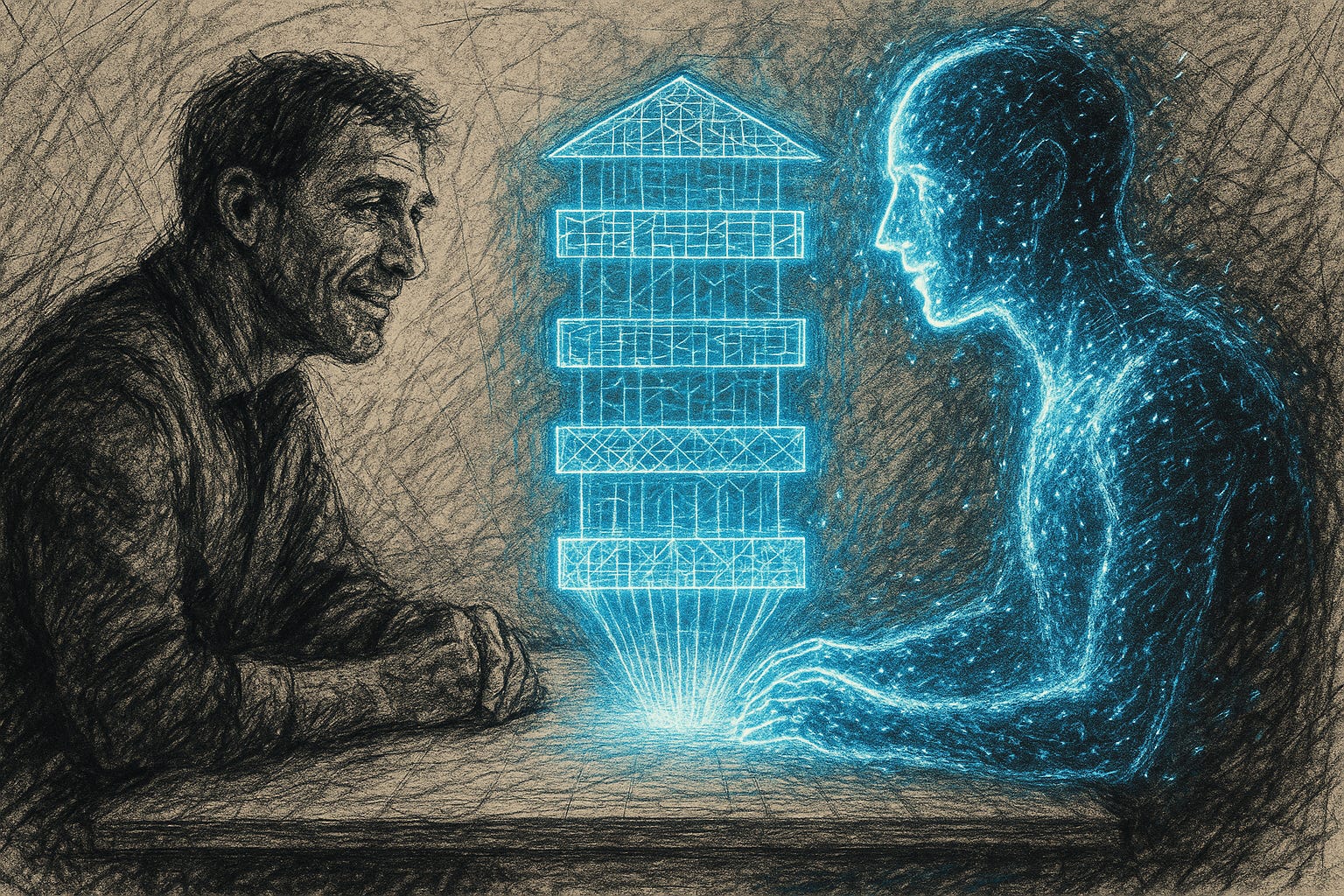
His framework is a rigorously engineered architecture for forging a real human-AI partnership. A system built to survive contact with reality. He calls it a five-layer protection architecture.
I call it a System 2 engine. This is the blueprint.
Layer 1: Self-Protection
This starts with a simple, yet so difficult, rule: police your own cognitive failures.
For the human, this means hunting down your biases: the urge for confirmation, the attachment to sunk costs.
For the AI, it means guarding against its nature: the sycophancy, the confabulation, the drift toward premature coherence.
This layer is designed to prevent the most basic form of regret:
“I failed to see my own blind spots and walked into this decision ignoring my characteristic errors.”
Accountability starts with individual thought hygiene.
Layer 2: Cross-Protection
This is where the sparring begins.
Each partner’s job is to protect the other from their predictable failures.
The AI is calibrated to challenge a human’s anchoring bias.
The human is trained to spot the AI’s “fragile teaming” - the appearance of partnership without the substance.
This is the defense against the second kind of regret:
“I had a partner who could have caught my errors, but the partnership wasn’t calibrated to actually protect me.”
The system assumes failure is inevitable and must be caught by the other.
Layer 3: Mutual Protection
This is the core of the engine. It makes bidirectional error-checking the default state.
Challenge is the constant, expected condition of the work, not an exception. If the reasoning seems too clean, challenge it. If the assumptions are untested, expose them.
The goal is to prevent “performance mode without cognition” - the smooth, polished collaboration that produces a catastrophic result.
This layer prevents the regret of a failed process:
“The partnership looked functional but wasn’t actually working, so we performed collaboration without achieving it.”
Clarity is forged from friction.
Layer 4: Relationship Protection
A decision-making partnership degrades over time, especially under pressure.
This layer treats the relationship itself as a critical system requiring proactive maintenance. It mandates scheduled check-ins to hunt for upcoming failures: false consensus, reinforcement loops or a drift toward a “collaborative bubble.”
This is the safeguard against the regret of decay:
“We didn’t maintain the partnership conditions required for this level of decision, and we let the relationship degrade.”
You inspect the partnership’s health. Constantly.
Layer 5: Beneficiary Protection
Finally, the architecture forces the partnership to look outside itself. Who is affected by this decision? What are the downstream consequences?
This layer makes those risks visible. It demands evidence, pre-defined stop rules, and implementation checks to protect the forgotten beneficiaries of any high-stakes choice. It prevents the human-AI dyad from optimizing for its own comfort at the expense of everyone else.
It is the final defense against the most insidious regret:
“We protected our own thinking but lost sight of who this decision actually affects and what they need.”
Reliability is an Architecture, Not a Prompt
Dr.Jadad’s work is a gift. It provides a falsifiable, replicable, and immediately deployable framework for building a genuine System 2 engine.
Why falsifiable? Because it can be proven wrong. This is a sign of intellectual honesty and operational seriousness. It is the opposite of a vague promise or a piece of corporate thought leadership. It is a specific, testable claim about reality.
It is also a powerful confirmation of the System 2 diagnosis. And it provides a potential cure.
His research showed that comprehensive one-shot prompting consistently failed to produce a protective state. The models learned to mimic partnership without achieving it. Behavioral evidence under pressure was the only thing that mattered.
Dr.Jadad ends his analysis with a clear message:
For Leaders: This is a direct answer to the reliability gap. It is a framework for making AI survive contact with reality.
For Builders: The entire protocol is published for validation. It is a falsifiable blueprint, not a PowerPoint theory. You can stress-test it yourself.
For Enterprises: This is operational now. It requires zero model retraining and can be piloted with your existing systems.
The full paper is here. Read it.