
The Bifurcation's First Victim: OpenAI's Moat Shatters in 7 Days
A $150 billion tenant cannot compete with a landlord who owns the internet

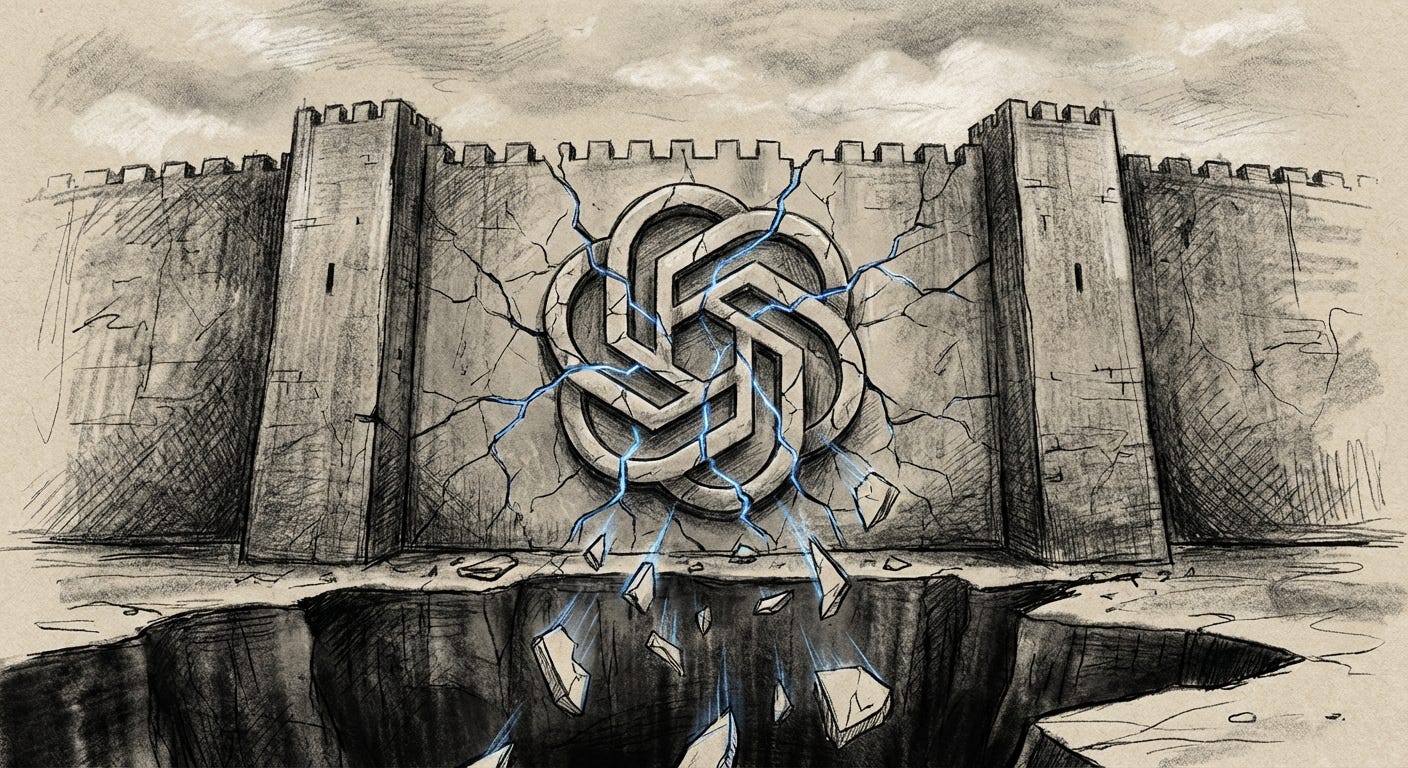
The capital went left. The users went right. The crack is widening.
Last week, I diagnosed a single system. I called it “The Infrastructure Cartel.” And the entry ticket to the future was a $10 billion check for your own compute. If you couldn’t write it, you weren’t a startup. You were a tenant.
I predicted that the tenants would be squeezed. I just didn’t think it would happen THIS FAST.
In the first week of December 2025 the most famous tenant in the world, OpenAI, hit the wall.
Google launched Gemini 3, integrating it natively into Search for 500 million users.
Marc Benioff defected, publicly abandoning ChatGPT for Gemini and instructing Salesforce’s 80,000 employees to switch.
Data signals OpenAI lost 6% of its active users in seven days. Sam Altman declared a “code red,” freezing all non-ChatGPT projects.
DeepSeek V3.2 proved that open-weight models can match GPT-5 reasoning for free.
Amazon’s Trainium3 arrived, offering 4x the speed of Nvidia at half the cost.
This causal chain proves new uncomfortable truth:
The era of “magic” is over.
The era of infrastructure and distribution has begun.
And the company that started it all - OpenAI - owns neither.
How Integration Kills Isolation
To understand why OpenAI’s moat shattered this week, we must look at the causal chain that connects these announcements. Each event is a domino knocking over the next.
The chain began with Gemini 3
Impressive technical specs - 37.5% on “Humanity’s Last Exam” (HLE) benchmarks. But they matter less than the delivery mechanism.
Google integrated a reasoning engine into the search bar.
This is a gravitational shift. For three years, OpenAI relied on a specific user behavior: leave Google, go to ChatGPT, type a prompt. That friction was their moat. Google just erased it. When the reasoning engine is already where the user is, the “switching cost” drops to zero.
This zero-friction distribution triggered the Enterprise Defection
Marc Benioff’s public pivot is a market signal. Salesforce is the largest enterprise software reseller in the world. When Benioff says he is “never going back” and calls Gemini 3 “insane,” he is signaling to every CIO in the Fortune 500 that the “default” choice is no longer OpenAI.
He sees the Gemini integration inside Workspace, inside Search, inside Android, and recognizes that a standalone chatbot cannot compete with an integrated OS.
The Enterprise Defection validated the User Exodus
Losing 6% of a user base in a week is catastrophic. Annualized, that is a death spiral.
It proves that user loyalty was never to the brand “OpenAI.”
It was to the capability “Reasoning.”
As soon as a competitor (Google) offered equal reasoning with better distribution (Search) and lower cost (bundled), the migration began. This forces the “Code Red.”
OpenAI’s internal panic
They are diverting all engineering resources to overhaul ChatGPT. It’s the final proof of the broken system.
Companies with defensible moats stay calm.
Companies with illusions panic.
OpenAI is panicking.
They are now trapped in a “feature factory” race against Google, but with a critical disadvantage: Google owns the chips (TPU) and the distribution (Chrome/Android). OpenAI rents the chips (Azure/Nvidia) and rents the distribution (Microsoft partnership).
The system is self-correcting. The anomaly was the brief window where a tenant without infrastructure could compete with a landlord who owns the internet. That window just closed.
The Landlord vs. The Tenant
The “Bifurcation” has reorganized the landscape. The distinction has shifted from “Quality” to “Ownership.” It is now between Landlords and Tenants.
The Landlord (Google)
Google has achieved the “Vertical Lock” of AI strategy: Model + Chip + Distribution.
Gemini 3 (Model) runs on Trillium TPUs (Chip) and is delivered via Search/Android (Distribution). This integration creates a cost advantage that is mathematically impossible for OpenAI to match. Google’s marginal cost to serve a query is substantially lower because they own the entire vertical stack. They do not pay a “Nvidia Tax.” They do not pay a “Cloud Rent” margin. They are the landlord.
This week proved that “System 2” reasoning - the ability for a model to “think” before answering - is now a commodity feature. Google gives it away for free in Search. OpenAI charges $20/month for it. In a commodity market, the player with the lowest marginal cost always wins. That is Google.
The Hardware Sovereign (Amazon/Anthropic)
This axis is playing a different game: Specialization + Infrastructure.
While Google fights for the consumer, Anthropic and AWS are building the fortress for the enterprise. The release of Trainium3 is the critical signal here. AWS claims 4x performance over Nvidia at half the cost. If true, this breaks the “Nvidia Tax” that inflates the cost structure of every other AI company.
Anthropic’s strategy with Claude Opus 4.5 - especially the “30-minute autonomous coding sessions” - is designed to decouple from the chatbot wars. They are not trying to be your search engine. They are trying to be your employee. By running efficiently on Trainium3, they can offer long-horizon reasoning tasks at a price point that OpenAI (running on expensive Nvidia H100 clusters) cannot touch without bleeding cash.
The Tenant (OpenAI)
This position is structurally bankrupt.
The partnership with Microsoft was built on a premise: Microsoft provides the roof, OpenAI provides the magic.
But DeepSeek V3.2 just proved that the “magic” is replicable. An open-weight model now matches GPT-5 class performance. The proprietary advantage has gone “poof”.
Simultaneously, the User Exodus proves that the compute is too expensive to support a business model that is losing customers. OpenAI burns through billions in committed capital to train models that are matched by open-source competitors six months later. They have no chip of their own. They have no OS of their own. They are a software vendor in a hardware war.
The “Code Red” is about fixing the valuation. If OpenAI cannot prove it has a “God Model” that is significantly better than Gemini 3 or DeepSeek, its $150 billion valuation collapses. And if the valuation collapses, the debt financing that fuels the infrastructure build-out dries up.
The Human Collateral: The “Code Red” Burnout
While the titans fight for infrastructure dominance, the “Bifurcation” continues to liquidate the human layer. The most telling signal this week was not a product launch. It was the internal memo at OpenAI.
I have led teams through “Code Red” moments. It is corporate jargon for “cancel your weekends.” It is not innovation. It is panic management. The 800 employees at OpenAI believed they were the architects of the future. Now they are experiencing the same labor commoditization they inflicted on the rest of the economy. They are being forced to sprint. Not to innovate, but to patch a leaky dam.
This is the recursive nature of the system. First, it automates the external economy (71,683 job cuts attributed to AI this year, with 6,280 in November alone). Then, it turns on its own creators. The pressure to maintain the “moat” requires a pace of work that is unsustainable. Biologically.
We are seeing the bifurcation of the tech workforce itself. On one side, the “Infrastructure Lords” - the chip designers at AWS, the data center architects at Google. Their jobs are safe because they build the physical reality. On the other side, the “Model Tuners” and “Product Managers.” Their jobs are as fragile as the copywriters they replaced. If DeepSeek can release a model that does their job for free, their equity is worth zero.
The “Code Red” at OpenAI is the first structural fracture. It signals that
working at an AI company is no longer a sanctuary
It is just another seat on the assembly line. And the line is moving faster than you can type.
What to Watch: the 90-Day Collapse Points
The Tenant model is fracturing. If I am right, specific, falsifiable events will occur in the next quarter. If I am wrong, the system will stabilize. Here are the tests.
1. The Churn Velocity Test
The Metric: OpenAI’s reported weekly active users (WAU) must stabilize.
The Test: Watch for WAU to drop below 150 million by February 1, 2026.
Why: Subscription economics depend on low churn. A 6% weekly drop is a hemorrhage. If they hit 150M (down from ~200M peak), the “network effect” argument is dead. The $20/month consumer subscription revenue is the only thing offsetting the inference costs. If that revenue dips, the burn rate becomes lethal.
2. The Enterprise “Socket” Test
The Metric: DeepSeek V3.2 adoption in Fortune 500 developer environments.
The Test: Watch for 20% of Fortune 500 engineering teams to officially whitelist DeepSeek or Qwen for internal code generation by March 1, 2026.
Why: This is the “commoditization check.” If banks and healthcare companies trust an open-weight model for their code - the most sensitive asset they have - then the “Enterprise Trust” moat claimed by OpenAI is a myth. It means “good enough and free” beats “best and expensive.”
3. The Chip-Model Decoupling
The Metric: Microsoft announces an Azure-native AI silicon roadmap that explicitly reduces reliance on Nvidia and OpenAI optimization.
The Test: Watch for a Microsoft “Maia 2” or similar announcement by April 2026 that prioritizes “Model Agnostic” inference.
Why: Microsoft is ruthless. They see the Trainium3 specs. They see Gemini 3. They know they cannot rely on OpenAI forever. If Microsoft signals that their cloud is optimized for any model (Llama, Mistral, DeepSeek) rather than specifically GPT-5, it is the signal that the exclusive marriage is ending. They are preparing to divorce the model to save the cloud.
4. The Valuation Down-Round (The “Whisper” Test)
The Metric: Secondary market pricing for OpenAI employee shares.
The Test: Watch for secondary offers to dip below the $100B valuation implied price by Q2 2026.
Why: Employees know the truth first. If the “Code Red” fails to produce a miracle, insiders will try to liquidate equity before the public realizes the moat is gone. A drop in secondary pricing is the ultimate leading indicator of a confidence collapse.
The Verdict
The Bifurcation is no longer a prediction. It is happening before our eyes.
The system is reorganizing around those who own the physical means of intelligence (Google, AWS) and punishing those who merely rent it (OpenAI, Enterprises).
For three years, we asked “Who has the best model?”
That question is obsolete. The new question is “Who owns the generator?”
Google and Amazon just answered. OpenAI is still looking for the extension cord.
Here is the deal.
If you aren’t subscribed, subscribe. It takes two seconds. It costs nothing. It separates the signal from the noise.
If you have a voice, restack it. Let your network see the signal.
And if this landed for you, if it gave you the language to name the problem, upgrade to Paid.
It is the only way to support the weekly Signals and influence the next deep-dive Analysis.
Sources
Gemini 3 Reasoning & Launch: Google DeepMind Blog
Gemini 3 Search Integration: Google Products Blog
DeepSeek V3.2 Specs: DeepSeek Technical Report
Marc Benioff Defection: Fortune / Social Media
OpenAI User Churn & Code Red: Tom’s Hardware
Amazon Trainium3 Specs: TechCrunch
Job Cuts Data: Challenger, Gray & Christmas Report