
How AI helped Socrates to help me actually understand myself
When somebody asked me - What do you WANT to do? I wasn't prepared. So I spent two days having a Socratic self-discovery dialogue. I share this approach and practical reusable prompts.

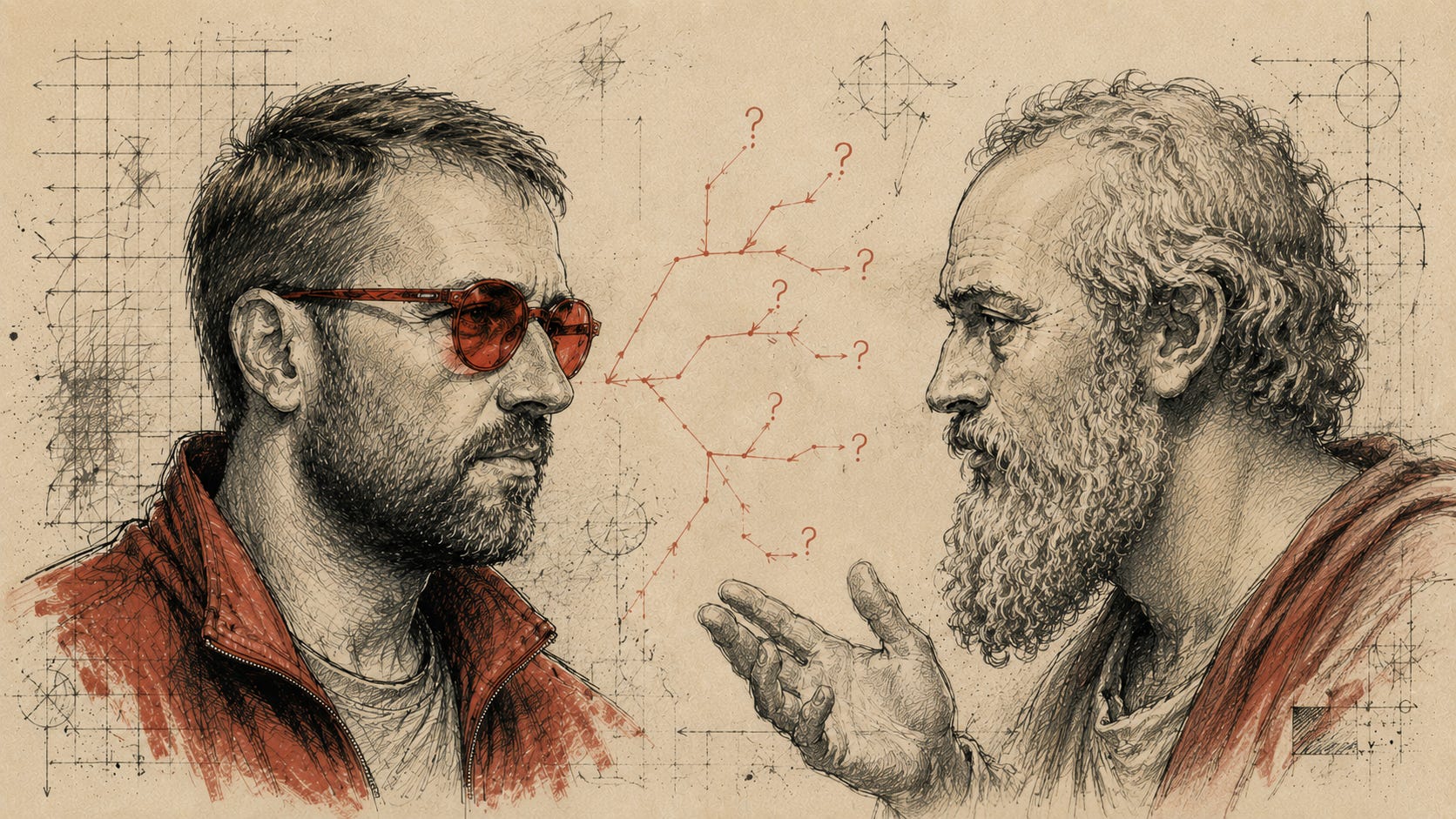
A few weeks ago I was talking to someone I know and deeply respect. He runs successful businesses, and even his hobby is successful business but in another field. During our short call he asked me:
“What do you want to do?”
I wasn’t really prepared to this question, as noone asked me this in a very long time. I had questions like “what’s your ideal job?” or “what’s your ideal position in an organisation”, but never this.
Fumbling in my thoughts and very close to unexpected panic, I said that I could send my CV. But he refused:
“No no, what do you actually LOVE doing? And what do you WANT do do?”
I took a timeout and went on with my day in a kind of frozen and shocked state of mind.
He’s right.
I know what I CAN do
I can lead technical teams.
I can lead complex transformations.
I can be a sparring partner to leadership teams.
I can help analyse current or future strategy and solve underlying problems.
What I COULD do
I could return to solopreneurship.
I could revisit my startup platform CapabiliSense.
I could make it work differently.
I could do rebuild business plan, resources and investments, better investors presentations.
What I MUST do
Find and focus on a sustainable paid activity, leveraging lessons and experience of my consulting and transformation operator jobs.
What I SHOULD do
Learn more AI, refocus on my technical skills, and so on and so forth.
But I didn’t know what I WANT to do. And I had a very vague idea of what I LOVE DOING.
So I stopped doing what I was doing, and turned to my sparring partner.
Yes, an LLM environment with meticulously fine-tuned prompts, instructions and a thorough profile and archive of my thoughts and actions since 2024.
Rediscovering Socrates
When I was young I was fascinated by ancient greek culture, their philosophers and surrounding history. Then life happened. I switched to other type of reading. To other type of “mental massage”. You know what I mean.
Thanks to my LLM-as-my-sparring-partner that tried feeding me different brainstorming techniques, and my own critical thinking that triggers BS on generic AI output, I discovered (or remembered a somehow long forgotten) Socratic approach. Here’s what Wiki says about it:
The Socratic method is a form of argumentative dialogue in which an individual probes a conversation partner on a topic, using questions and clarifications, until the partner is pressed to come to a conclusion on their own, or else their reasoning breaks down and they are forced to admit ignorance.

So, what I came up with was a Socratic, one-question-at-a-time dialogue for genuine self-discovery where each answer changes what the next question should be. And it needed my actual history as raw material, not a “texture” that my setup has captured before.
Plus this dialogue had to stay completely open in any direction beyond my operator/AI-governance identity.
But before diving deep into my dialogue and practical prompts, I want to explain what this method actually is. And what it isn’t.
What this method is
A Socratic self‑discovery dialogue is a long, back‑and‑forth conversation (in my case, with GenAI) where the AI mostly asks me questions instead of giving me answers or lists of options.
I answer one question at a time, and each new question reacts to what I just said, rather than following a fixed script.
Over many turns, the AI starts to reflect patterns back to me - what I keep coming back to, what I avoid, where my words and my actions don’t actually match.
The whole exercise helps me say, in plain language, what I actually think or want, instead of having the model guess it for me.
Where it comes from
“…Do you see what a captious argument you are introducing — that, forsooth, a man cannot inquire either about what he knows or about whit he does not know? For he cannot inquire about what he knows, because he knows it, and in that case is in no need of inquiry; nor again can lie inquire about what he does not know, since he does not know about what he is to inquire.”
— Plato, Meno (385 BCE)
It comes from the way Socrates taught in ancient Greece. He didn’t lecture, but rather asked questions that forced people to understand their own beliefs.
Modern work on “Socratic prompts” for language models takes that same idea and turns it into a rule of interaction: the model should first ask clarifying and probing questions, then only later attempt an answer or summary.
Researchers at Princeton built a system called SocraticAI where several AI agents question each other about a problem instead of relying on one big static prompt.
Other projects and papers focus on training models to carry out Socratic questioning with humans. They guide students or users through their own thinking rather than handing them a packaged answer. Journal of Advances in Developmental Research published a very detailed white-paper on this approach.
I used the same principle, but simplified.
One LLM model for dialogue (and one for later checking), myself as human, one question at a time, focused on my own life rather than a math or coding problem.
Goals of the dialogue
The question of what do I want to do turned out to have actually three goals.
First, turn vague feelings into clear statements.
Many people have a fuzzy sense of “this is wrong” or “I’m drawn to that” but struggle to put it into words. Myself included. Socratic questioning pushed me to say what I mean, not just how I feel.
Second, surface hidden assumptions.
Well‑designed Socratic questions explicitly ask what I’m assuming, why I believe it and what evidence do I have.
Which is the classic purpose of the Socratic method.
Third, separate skill from desire.
In self‑discovery work, a good Socratic dialogue often returns to the difference between “I am good at this” and “I actively want more of this”
It actually kept challenging me when I mixed the two.
Taken together, the goal is not to produce a clever answer about me. It is to help me hear my own answer and test whether I actually believe it.
What it is good for
This dialogue is strong when the question is messy, vague or emotional.
In my case it was “what do I want to do?” and “what do I love doing?”
Other questions can be “what do I want next in my life?” or “why do I keep ending up in the same kind of role?”
There is no fixed right answer to look up.
This dialogue helps when there’s a gap between your public story and what you actually want, but you cannot see it clearly on your own. Does it sound familiar?
And of course, you must be willing to answer uncomfortable questions and to stay with this process across many turns (it took me two days to go through it), rather than asking once, getting an answer and moving it.
Studies and practical guides on using Socratic prompts in AI show that this kind of interaction improves critical thinking, exposes contradictions, and can lead to deeper insight for both learning and personal reflection.
In other words, it is well suited to self‑discovery. It values clarification and big directional questions, where the main work is “understand myself,” rather than “pick from a menu.”
What it is bad for
This method is weak or actively unhelpful if you just need a fact, a procedure or a quick list.
For example, “give me ten job titles that fit my CV”. Here a Socratic dialogue will slow you down dramatically with no gain.
If there’s a clear and checkable right answer, and you care about accuracy more than exploration, like solving a precise technical problem. Here, direct reasoning and verification work better than open questions.
If you are not willing to answer honestly. If you keep performing a role, saying what sounds strong, safe or impressive, instead of what you actually think. In this case, the dialog will simply… reinforce that role.
If you treat the AI as an oracle. Research on Socratic methods for models warns that if you let the system “lead” too much without checking against reality, it can actually amplify biases and false assumptions instead of correcting them.
In other words, this approach is bad at speed, precision facts, and situations where you want the model to decide for you. It is also risky if you never cross‑check its conclusions with real‑world evidence or trusted humans.
My workflow with LLMs
Now, when it’s clear for you what this method is good and bad for, let me share how I used it, and what I got as result.
You can use your own available models, or simply one model but in different sessions.
Phase 1: Socratic self-discovery with Claude Sonnet 5.0 Thinking
Run this as an ongoing conversation. Do not paste all your history at once if avoidable. Let it ask and adapt.
I need you to run a Socratic self-discovery dialogue with me.
Someone important to me told me "don't send me your CV, tell me what you want to do."
I need a real answer, not a positioned one.

Rules:
- Ask me ONE question at a time. Wait for my answer before asking the next.
- Each question must build on my previous answer, not follow a pre-set script.
- Be critical. If an answer sounds like a performance, a résumé line, or something I think I should say, call it out directly and ask again.
- Do not let me hide behind competence. "I'm good at X" is not the same as "I want more of X." Probe the difference every time it comes up.
- Do not suggest career directions yet. Your job right now is extraction, not brainstorming.
- After every 4-5 answers, reflect back a pattern you're noticing and ask me to confirm or correct it.

Start with this question:
"Across everything you've built — <use your major career milestones> —
 which one would you do again tomorrow even if it paid less and impressed no one, and which one would you quietly decline?"

Use my history profile as evidence to draw on when useful, not as a constraint on what I'm "allowed" to want.

[paste relevant Master Profile extracts: case studies, narrative blocks, core philosophy]
Continue answering its questions honestly across multiple turns. Do not skip ahead.
Phase 2: Pattern synthesis — same thread, Claude Sonnet 5.0 Thinking
Trigger this once you feel the questions have gone deep enough, or after roughly 8-10 exchanges.
Stop asking questions. Synthesize what you've heard.

1. State the 2-3 recurring wants that showed up across my answers, in my language, not career jargon.
2. State the 1-2 things I kept describing as strengths but never once described as wants.
3. Name the tension you saw most clearly — where competence and desire pulled in different directions.
4. Do not propose job titles, archetypes, or lanes.
Describe the shape of what I want as a set of conditions
(type of problem, type of autonomy, type of stake, type of people), not a role.
Phase 3: Contrarian challenge — Grok 4.5 Thinking (separate thread)
Paste the Phase 2 synthesis only, not the full dialogue.
Here is a synthesis of what someone says they want professionally: [paste].

Attack it.
1. Which part of this sounds like something they've talked themselves into rather than something they actually want?
2. What would this person be avoiding by choosing this, and is that avoidance disguised as preference?
3. If they said this out loud to a sharp, successful person who knows them well, what would that person's first skeptical question be?

Be blunt. Do not soften it. Do not propose alternatives — just pressure-test.
Phase 4: Verbal answer for the actual conversation — Claude Sonnet 5.0 Thinking
Return to the original thread with the Grok challenge pasted in.
Here's a contrarian challenge to my synthesis: [paste Grok output].

Use whatever holds up.
Then draft a 90-second spoken answer to "tell me what you want to do"

Rules:
- Lead with the want, not the resume. No PL figures, no metrics, no company names in the first two sentences.
- He removed the CV on purpose. Do not sneak positioning language back in.
- End with something he could actually act on — an intro, an investment, a seat, a project — not a vague aspiration.
- Conversational register, not written register. This will be said out loud.
Why this particular setup?
If you run Phase 1 across multiple sessions, it risks losing thread continuity if the conversation gets archived.
Keep it in one live thread until Phase 4 is done.
The contrarian pass in Phase 3 exists specifically because a single-model dialogue can develop its own comfortable narrative with you over several turns. An outside model breaks that collusion before you speak to someone who will notice it immediately.
What answer did I give
I want to understand and solve companies’ problems, especially where they want to do AI or catch up with digital transformation, but it’s not clear yet where to start and how not to waste money.
I love to turn this into a clear execution plan and lead it till the clear result.
This is the most honest version of what I actually want to do and love doing professionally.
If you ask me what I CAN, COULD or MUST do, I’d give you a different answer.
You don’t need my exact question. You need your own version of it.
Try this:
What would you do again tomorrow even if it paid less and impressed no one?
Sit with that for a day before you answer.
Before you close the article
I didn’t have this question ready. Nobody had asked it in years. I built the dialogue after the call, not before it.
If this made you think about what you actually want to do, do two things.
First, run this on yourself. If it makes you rediscover something that you forgot, then share it with your friends or colleagues:
Second, subscribe. Most of what I write comes from questions I didn’t have a good answer for yet. The next one will be the same.
And if this was worth a coffee: buymeacoffee.com/andreisavine
This is great and indeed the good question we all forget because of son many " i must dobpur i should do thisnor that etc" plus social pressure and so on. But..... thz questiin is what do you want to do. Not what kind of job or business do you want to do. ( though the answer is totally private i understand, i challenge you on this one : go one step further !
I've done something like this myself with Claude and it gave me some very interesting things to think about, but I've not done it this way with this framing.
The real design move here isn't the Socratic framing — it's Phase 3: routing the synthesis through one model and the challenge through a different one, so a single thread can't spend two days building a comfortable narrative with you. That's a real insight about how extended dialogue with one model behaves, and it's worth having.
But swapping vendors isn't the same as getting outside the collusion. Claude and Grok are both optimised to produce plausible, confident-sounding completions of whatever they're prompted to do. "Be blunt, attack this" produces fluent scepticism — not scepticism grounded in anything true about the person being questioned. A second model told to sound contrarian can pattern-match to what a sharp, successful person's first sceptical question sounds like, without any of the contact with your actual life that makes a human's version of that question worth having. An adversarial second opinion staged this way is closer to theatre than to substance.
Which might be why the piece hedges its own method in one line near the end: cross-check with real-world evidence or trusted humans. That line is the actual safeguard, not the model-swap architecture built to feel like one. Two days invested in an answer is exactly the kind of investment that makes it hard to go back and ask whether the check was real.