
The $7.99 False Identity
The Davos elite are fighting an Information War. The market already has a weapon for less than a Netflix subscription.


This morning, the World Economic Forum opens in Davos with a darkness rarely seen in its 56-year history. The just-released Global Risks Report 2026 has ranked "Geoeconomic Confrontation" as the #1 threat to stability, followed immediately by "Misinformation and Disinformation" at #2.
But while they debate in Switzerland, the market has already distributed the weapon for this war.
The “Information Weapon” they fear - the ability to generate undetectable, biometrically-perfect synthetic identities - is not restricted to the GRU or the CIA. It is not a state secret.
As of January 2026, it is a $7.99 consumer subscription.
The paradox is scale. While Davos debates "Geopolitics," the market has finished the commoditization. The "Deepfake" is no longer a complex media problem. It's a cheap tool. And the horror is in the banality of the price.
When “Reasoning” Meets “Motion”
To understand why this is different from last year, we must look at the technical stack. In 2025, “Deepfakes” were visual replacements - masks that sat awkwardly on a face, prone to jittering if you turned your head too fast. They failed the “Liveness Check” because they couldn’t respect physics.
That limitation ended with the fusion of two specific technologies.
The Mask: Gemini 3.0 (Nano Banana Pro)
Google’s Gemini 3.0 architecture (powered by the Nano Banana Pro model) introduced "Physics-Based Topology" to image generation. Unlike previous models that simply predicted pixels based on statistical likelihood, Gemini 3.0 understands 3D topology and lighting physics. It models the bone structure and the way light hits the skin. Perfectly.
As consequence, it generates a synthetic identity that passes the texture analysis algorithms used by standard ID scanners. The “Mask” is now mathematically indistinguishable from a photo.
The Driver: Kling 2.6 Motion Control
Released in December 2025, Kling 2.6 introduced “Motion Control”. This feature allows a source video to “drive” a target image.
Now, an attacker can sit before a webcam and perform the specific “liveness gestures” (blink twice, look left, nod) required by a banking app or onboarding platform. The software maps these micro-movements onto the synthetic Gemini face in near real-time.
The result is a “Puppet” that follows orders. When the banking app says “Smile,” the attacker smiles, and the synthetic face smiles with perfect biometric fidelity. The cost to assemble this stack is approximately $8 per month.
The “Binding” Crisis
The failure is not in the government ID. It is a Camera Injection Attack targeting the Binding Layer.
According to the industry standard defined by Regula Forensics, remote identity verification operates on a strict 5-step “Holistic Workflow”.
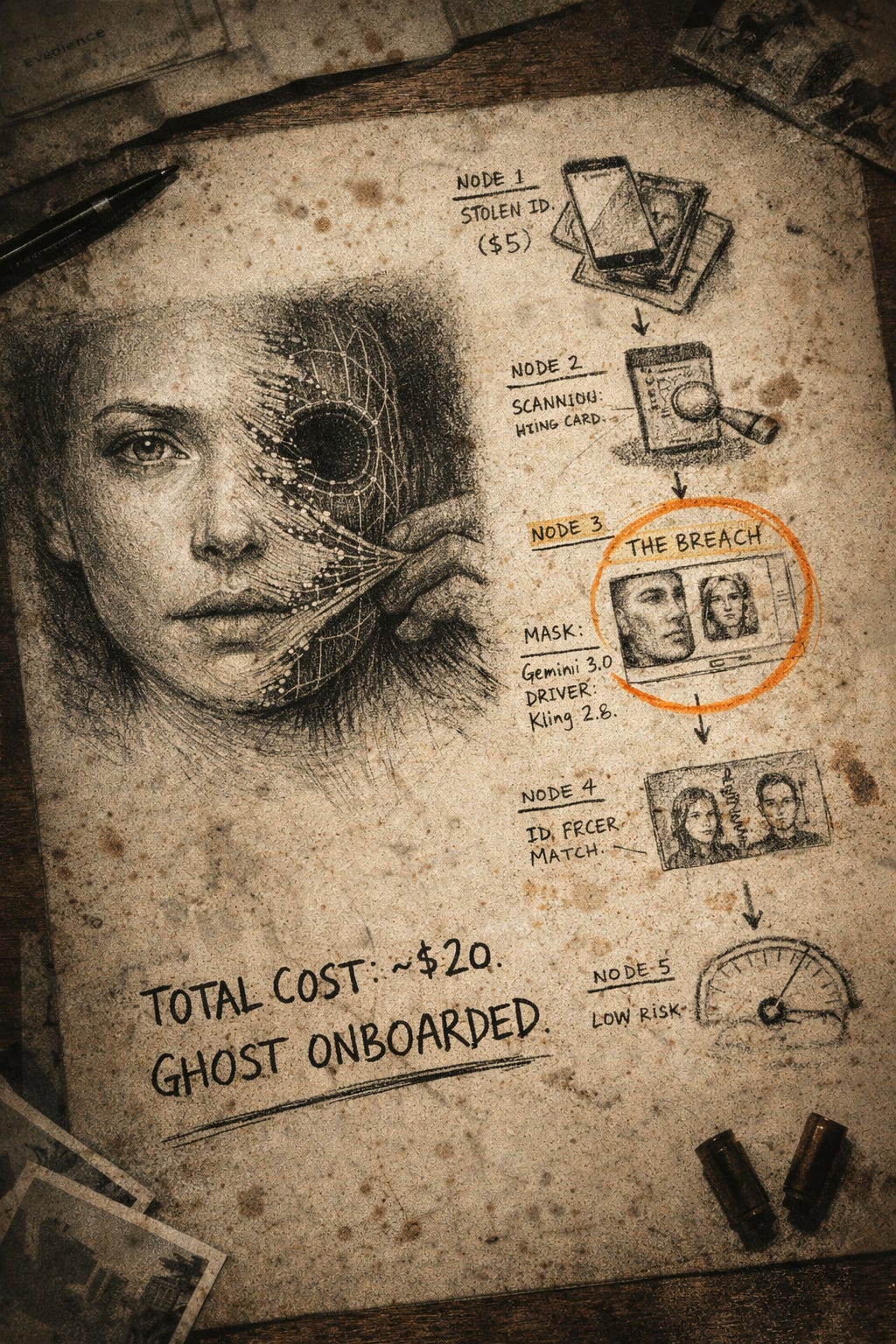
The Kling/Gemini stack exploits the transition between Step 3 and Step 4.
The Standard Logic Chain (in Regula Taxonomy):
Step 1: Document capture: The attacker uploads a high-resolution scan of a real stolen ID. Result: Pass.
Step 2: Document authentication: The system verifies holograms and VIZ data on the stolen ID. Result: Pass.
Step 3: Biometric capture (The Breach)
The Requirement: The user must prove presence via “active liveness detection” - turning head, blinking.
The Exploit: The attacker uses Kling 2.6 Motion Control to drive the synthetic face. Because the motion is fluid and the lighting is physically consistent (Gemini 3.0), the Liveness algorithm validates the feed as human.
Step 4: Face matching
The Requirement: The system compares the “Live” face (Step 3) to the ID Document (Step 2).
The Exploit: Because the synthetic face was generated from the ID photo using Gemini 3.0, the mathematical resemblance is perfect.
Step 5: Risk scoring
The Result: The system sees a valid ID, a “live” person, and a perfect match. It generates a “Low Risk” score.
The system has just on-boarded a ghost for around $20.
The End of Remote Trust
The implications go far beyond credit card fraud.
The “Return to Office” (RTO) Mandate becomes a Security Protocol
For five years, the debate over RTO has been cultural (”collaboration vs. flexibility”). In 2026, the debate ends.
If a CIO cannot be sure that the person logging into the VPN is the employee they hired, the risk profile of remote work becomes unsustainable.
The Scenario
A “Ghost Employee” is hired remotely.
They pass the video interview using the Kling stack.
They receive the laptop. They access the repo.
They exfiltrate the data. They disappear.
The Policy Shift
Companies will be forced to bifurcate their workforce.
High-trust roles (developers, finance, strategy) will be recalled to the office not for “culture,” but for biometric certainty.
You cannot fake a badge swipe.
The office becomes the only “Verified Zone” left.
The End of the “Video Selfie” Economy
The entire gig economy - Uber, Airbnb, Upwork, OnlyFans, etc. - relies on low-friction video verification to scale.
If “Liveness” is broken, these platforms face a choice:
Accept the Fraud: Allow a percentage of their supply side to be synthetic, bots driving accounts.
Kill the Friction: Introduce hardware keys (YubiKeys) or in-person checks (Post Office verification), which kills their growth loops.
The “frictionless onboarding” era is over.
The Geopolitical "Denial of Reality"
This is the "Geoeconomic Confrontation" Davos fears.
If video proof of identity can be forged for $15, then real video proof can be dismissed as a forgery.
In the coming "Information Cold War," this tool allows any state actor or corporation to dismiss inconvenient evidence - a war crime, a protest, a whistleblower statement - as "just another Kling render."
The danger is not just that we believe the lie. It is that we lose the ability to prove the truth.
When everything could be fake, nothing is real.
The 90-Day Collapse Points
If this diagnosis is correct, we will see the following specific breaks by April 2026:
Test 1. The “Ghost Hire” Disclosure
Watch for a Fortune 500 company to publicly admit to a data breach caused by a synthetic employee who passed video onboarding. This will be the “Patient Zero” event for the new RTO wave.
Test 2. The KYC Liability Shift
Watch for a major neo-bank (Revolut, Monzo, or Chime) to introduce a mandatory “NFC-only” onboarding tier (requiring a chip passport scan), effectively admitting that video verification is compromised.
Test 3. The RTO Pivot
Watch for a major tech CEO to cite “Security and Identity Verification” instead of “Collaboration” as the explicit reason for a strict 5-day office mandate in Q2.
The Verdict
The “Blue Checkmark” era of digital identity - where a verified account meant a verified human - is ending.
The delegates in Davos are drafting treaties for a war that has already been lost in the app store.
We are entering a Zero-Trust Internet, where the only proof of humanity is physical presence. If you didn’t shake their hand, you didn’t hire them.
Here is the deal.
If you aren’t subscribed, subscribe. It takes two seconds. It costs nothing. It separates the signal from the noise.
If you have a voice, restack it. Let your network see the signal.
And if this landed for you, if it gave you the language to name the problem, upgrade to Paid.
It is the only way to support the weekly Signals and influence the next deep-dive Analysis.
Sources
This signal analysis is based on a forensic review of software release notes, cybersecurity risk assessments, and verified financial fraud reports. All technical claims are grounded in primary documentation from the relevant vendors and industry bodies.
Global Risks Report 2026 (World Economic Forum, Jan 14, 2026): Ranking “Geoeconomic Confrontation” and “Misinformation” as the top global risks, establishing the Davos agenda context.
Gemini 3.0 / Nano Banana Pro Documentation (Google DeepMind, Late 2025): Technical verification of the “Thinking Mode” architecture and its ability to generate physically consistent 3D topology in image synthesis.
Kling 2.6 Release (Kuaishou, Dec 2025): Release of the “Motion Control” feature, enabling source-video-driven animation of static images.
Remote Identity Verification 101 (Regula Forensics, Sep 2025): Industry-standard definition of the 5-step verification workflow, establishing the specific “active liveness” requirement.
AI-powered Liveness Detection Software (Sumsub, Sep 2025): Technical detailing of the specific biometric checks (landmark analysis, texture verification) used in standard KYC, confirming the vulnerability to physically consistent 3D masks.
2026 Identity Fraud Forecast (Experian, Jan 2026): The rise in “synthetic identity” fraud and its impact on remote hiring and financial onboarding.